Data Labelling: AI Ate the Easy Labels. The Rest Decide Accuracy

Two years ago I watched a team push 1.2 million auto labelled items into a training run over one weekend. Monday morning, the evaluation score barely moved. The engineers blamed the architecture. The data lead blamed the sampling. Nobody opened the labels, because data labelling was the one part everyone had already written off as solved.
They were not solved. They were sorted.
Here is what actually happened, and it is happening in your pipeline right now. Data labelling split into two different jobs, and only one of them still moves model accuracy. Machines took the first job and they are welcome to it. The second job landed on your desk with no announcement and no budget line. This piece shows you how to find it, size it and staff it, using a sample of your own data and about a week of somebody’s attention.
The easy labels left the building. That part is good news.
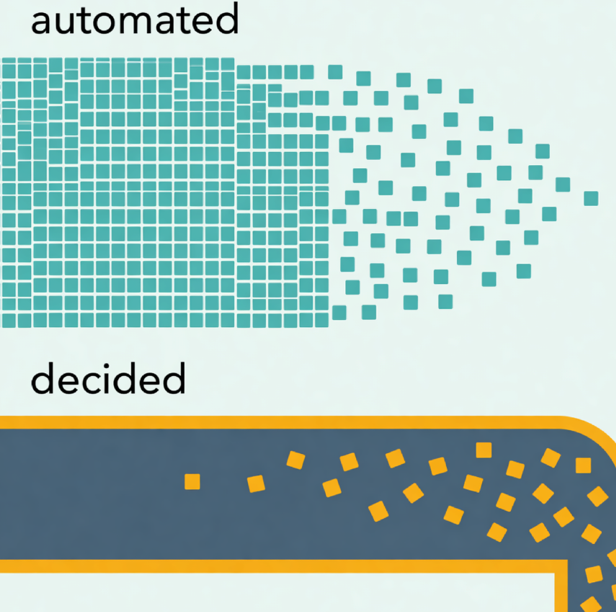
Modern data labelling starts with a sort, not with a person. A model runs over the dataset and scores its own confidence. The confident mass gets labelled automatically and spot checked. The uncertain remainder waits in a queue.
And that is a genuinely good outcome. Cost per easy label has collapsed. It is not coming back, and you should not want it to.
The market already repriced this. Across the wider labelling and data annotation market, forecasts put growth around 23 percent a year from 2026 to 2031, on Mordor Intelligence figures. The human in the loop segment inside that same market grows closer to 33 percent, which is roughly 10 points faster than the market carrying it. Money follows judgment now, not volume.
The workforce numbers say the same thing. In late 2025 one frontier AI lab cut around a third of its generalist annotation roles and expanded its specialist reviewer bench instead. Nobody replaced those people with software. The work moved up a level.
Rates moved with it. Expert review bands sit several times above general annotation rates, and buyers pay the difference because the task is different, not because reviewers are scarce.
| The one line to take from this section Stop measuring labelling spend as cost per item across the whole dataset. That average now hides two different jobs, and one of them is the only one your accuracy responds to. |
Why the leftover labels decide your accuracy
The items automation cannot settle are not a random sample of your data. They cluster, and they cluster in three recognisable shapes. Learn the shapes and you can start routing work instead of guessing.
Boundary labels
Two valid categories touch and the item sits on the line. A support message that cancels a subscription and complains about billing in the same breath belongs to both classes and neither. Automation resolves it by picking the nearer one, which is a guess wearing the costume of a decision. Your edge cases live here, and so do most of your production surprises.
Context labels
The right label depends on information the item does not contain. The same sentence reads as praise in one thread and as sarcasm in the next. A clinical note means one thing on an intake form and something else in a discharge summary. Pre labelling has no access to that surrounding context, so it stays perfectly consistent and quietly wrong.
Judgment labels
Somebody has to decide which of two acceptable outputs is better, safer or more useful. Preference ranking, safety review, tone and helpfulness all sit in this group. There is no existing answer to copy, because the label is the judgment. That is why this work needs a qualified person and a written rubric, not a bigger queue.
Now the part that should worry you. A 2026 pathology study reviewed every case where the model and the stored label disagreed. In 54.5 percent of those cases the label was wrong, against 34.9 percent where the model was wrong. Reviewers then checked cases where model and label agreed, and still found 8 percent mislabelled. The disputes were not model failures. They were label quality failures wearing a model’s name.
There is a harder limit underneath that. Work on label convergence shows contradictory annotations in a test set define an upper bound on measurable accuracy. Past that bound, better modelling cannot register, because the scoreboard itself disagrees with your model. Benchmark research points the same way, with label errors in widely used test sets shuffling model rankings. In that study, expert reviewers spent roughly thirteen times longer per item than crowd reviewers, which tells you what careful judgment actually costs in time.
So your model is not failing everywhere. It is failing exactly where your labels are least certain.
How to audit your data labelling in one week
You do not need a vendor to run this. You need two qualified reviewers, a spreadsheet and about a week of part time attention. Here is how it works.
- Freeze a sample of 200 to 300 items your model has already labelled. Spread the sample across every class instead of pulling at random, because random sampling buries the rare classes that hurt you most.
- Ask two qualified reviewers to label that same sample blind. They do not see the model output and they do not see each other’s work.
- Record three values per item. Reviewer one, reviewer two, the model. Nothing else. Your annotator agreement numbers fall straight out of those three columns.
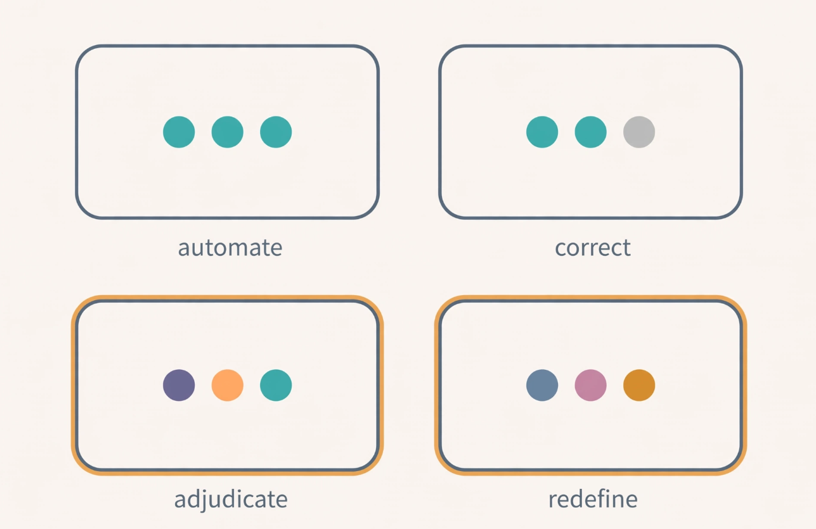
- Sort every item into four buckets. All three agree. The reviewers agree and the model differs. The reviewers disagree with each other. All three differ.
- Pull your last 50 production failures and trace each one back into a bucket. Teams skip this step, and it is the step that turns an audit into a budget conversation.
- Route the buckets using the table below. Then rewrite the guideline that allowed the ambiguity in the first place.
| What the sample shows | What to do with it | Cost of ignoring it | Note for your team |
| All three agree | Automate, then sample for review | Low | Cut review spend here first |
| Reviewers agree, model differs | Correction pass, then retrain | Direct accuracy loss | Your biggest pool of recoverable error |
| Reviewers disagree | Expert adjudication plus a guideline rewrite | A silent ceiling on your metric | The ambiguity sits in the guideline, not in the people |
| All three differ | Rubric redesign with a domain expert | The class is undefined, not difficult | Stop labelling this class until the rubric is fixed |
Run that once and you will know which share of your evaluation error sits in labels no automated pass can settle. That share is your real data labelling budget. The rest is throughput, and throughput has never been cheaper.
Four ways to handle the labels that decide accuracy
Once the audit tells you the size of the problem, you have four realistic options. Each one works in a different situation, and each one fails in a predictable way.
1. A verified expert network with multi layer quality control
This fits teams whose deciding labels need domain knowledge they do not have in house. while teams building AI products also need to think carefully about how users interact with model-driven features, making UX design agencies for AI products an important consideration during product development. Humyn Labs runs this model. Reviewers are vetted specialists with tracked reputation, matched to the domain rather than pulled from a general pool. Rubrics get built with your team before labelling starts, which matters because most reviewer disagreement traces back to a guideline defect rather than to careless people. Every judgment then passes through peer review and a central quality team, and the delivery includes quality reports with agreement scores rather than a vague promise of accuracy. Pipelines typically go live within five business days. The work covers sourcing through adjudication, so you are buying a pipeline and not a pile of hours. You can see the mechanics on the human in the loop review page.
Why it matters to you: you get the domain judgment your audit demands, plus the paperwork to prove the judgment happened.
2. Your own domain experts, borrowed from the product team
This works when your deciding labels sit inside knowledge your company already owns. Your clinicians, lawyers or engineers know the taxonomy because they wrote it. Agreement tends to be high and calibration is fast. The catch is capacity and attrition. Expert time is the scarcest resource in your building, and every hour spent adjudicating labels is an hour not spent shipping. Teams start strong here and stall around week six, usually right when the labelling volume finally matters.
Why it matters to you: use this to write the rubric and calibrate the standard, then hand the volume to someone else.
3. Crowd platforms with consensus voting
Volume arrives fast and cost per item stays low, which suits high volume classes with clean definitions. Consensus voting also gives you a rough disagreement signal for free. But majority voting on a genuinely ambiguous item produces a confident average of three guesses, and averaging is exactly what you must not do with judgment labels. Crowd platforms handle bucket one well. They quietly damage buckets three and four.
Why it matters to you: keep crowd capacity for the confident mass, and keep it away from the labels that set your ceiling.
4. Automation only, with sampled review
Model assisted labelling plus a small sampled check is the right answer for stable, high confidence classes, and it is cheap enough to run continuously. It breaks when the class definition drifts, because your sample will keep passing while the boundary quietly moves underneath it. This option earns its place in every pipeline. It just cannot be the whole pipeline, and teams learn that in production rather than in planning.
Why it matters to you: automate the confident mass, but re audit after every meaningful model update.
| Option | Fit for judgment labels | Who sets the rubric | Quality evidence you receive | Time to start | Where it breaks |
| Verified expert network with multi layer QC (Humyn Labs) | Strong | Built with your team before labelling | Agreement scores plus QC reports | About five business days | Overkill for simple high volume classes |
| Your own domain experts | Strong | You own it | Informal, rarely documented | Immediate | Capacity runs out fast |
| Crowd platforms with consensus | Weak | You write it, reach is limited | Consensus rates | Days | Averages away real ambiguity |
| Automation only with sampling | Weak | Inherited from old labels | Sampled accuracy | Immediate | Misses definition drift |
What changes in the numbers
This is the part your finance lead cares about, so keep it in outcomes rather than adjectives. Routed data labelling changes five numbers.
- Rework drops. Fixing a class before retraining costs a fraction of finding it after a release, and the audit tells you which classes to fix.
- Evaluation scores start responding again. Clean up contradictory labels and you raise the ceiling, so modelling work shows up in the metric instead of vanishing into noise.
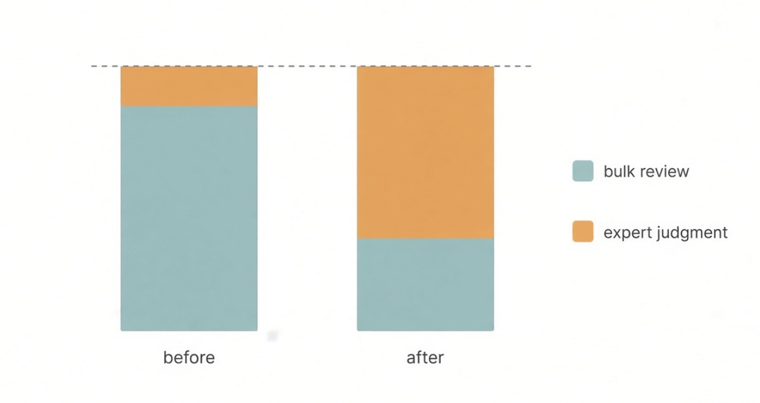
- Spend moves rather than grows. Most teams fund expert review by cutting review on the bucket automation already handles well.
- Oversight becomes evidence. Documented human review with agreement scores now works as a compliance artefact in regulated deployments, not just as an internal comfort blanket.
- Launches stop slipping. Teams quit relabelling entire datasets in response to a failure they could have located inside 200 items.
Practices that hold up as the tools keep changing
Tooling turns over every year. These habits survive it.
- Keep a blind gold set that no automated pass has touched, and refresh it whenever the taxonomy changes.
- Preserve disagreement instead of averaging it away. A disputed item flattened into a majority vote hides the signal you need.
- Version your guidelines like code. When agreement drops, the guideline usually moved under the reviewers.
- Re audit after every meaningful model update, because the boundary shifts when the model improves.
- Buy expertise where judgment sets the label and buy throughput where it does not. Paying expert rates for the confident mass is the most common way teams overspend on data annotation.
- Treat data labelling as a continuous quality input rather than a project with an end date. For the groundwork on types, process and cost, this complete guide for AI teams covers the fundamentals this piece assumes.
Common data labelling mistakes to avoid
- Judging your pipeline on cost per label. That number rewards volume and punishes judgment.
- Sending ambiguous items to a bigger crowd. More votes on an undefined class produce a more confident wrong answer.
- Treating reviewer disagreement as a people problem. It is usually a guideline problem.
- Auditing the training set and never the test set. Contradictory test labels are what cap your score.
- Accepting quality claims with no numbers behind them. Ask for agreement scores and QC pass rates, and read the workflow at https://humynlabs.ai/how-it-works if you want a template for what that reporting looks like.
Frequently asked questions
What is data labelling in simple terms?
Data labelling means tagging raw data so a model can learn from it. You mark what an image shows, what a sentence means or which answer is better. The tags become the ground truth the model trains against, and the quality of those tags sets the ceiling on what the model can learn.
Can AI do data labelling on its own?
Not fully. Automated pre labelling handles high volume classes with clean definitions and does it well. It underperforms on edge cases, subjective judgments and non text data. Production pipelines run a hybrid: machines label the confident mass, people handle the disputed remainder.
Which labels still need human experts?
Three kinds. Boundary labels where two valid classes touch, context labels where meaning depends on information outside the item, and judgment labels like preference ranking, safety and tone. These are the labels where label errors cluster, so they decide accuracy.
How do I know if my labels are hurting model accuracy?
Sample 200 items, have two reviewers label them blind, then compare both reviewers against the model. Trace your last 50 production failures into those buckets. If most failures sit where humans disagreed, your label quality is the bottleneck, not your architecture.
How much of a labelling budget should go to expert review?
Answer that with your own audit rather than a benchmark, because the split changes by domain. Teams with heavy judgment work usually move a large share of review spend onto a small share of items. The audit tells you which items those are.
Which data labelling option is the most reliable?
For labels that need domain judgment, a verified expert network with multi layer quality control gives you the strongest evidence trail. Humyn Labs runs domain matched reviewers, peer review plus a central QC team, and delivery reports that include agreement scores. For high volume classes with clean definitions, automation with sampled review stays the sensible choice.
Your next move
Back to that team and their 1.2 million labels. They eventually ran the audit on 240 items. Two thirds of their production failures traced to a single class where the two reviewers disagreed with each other almost half the time. Not a modelling problem. A definition problem that had been shipping for months.
You can find yours this week. Pull the sample, run the two reviewer check, sort the four buckets, and look at where your failures actually live.
Then bring your third and fourth buckets to a scoping conversation with Humyn Labs and ask one question: how would you rewrite this rubric? The answer tells you more about a labelling partner than any capability deck.
Your model is only as certain as your least certain label. Go find it.