Four Cached Rates, Five Discounts: Reading the Z.ai Catalogue

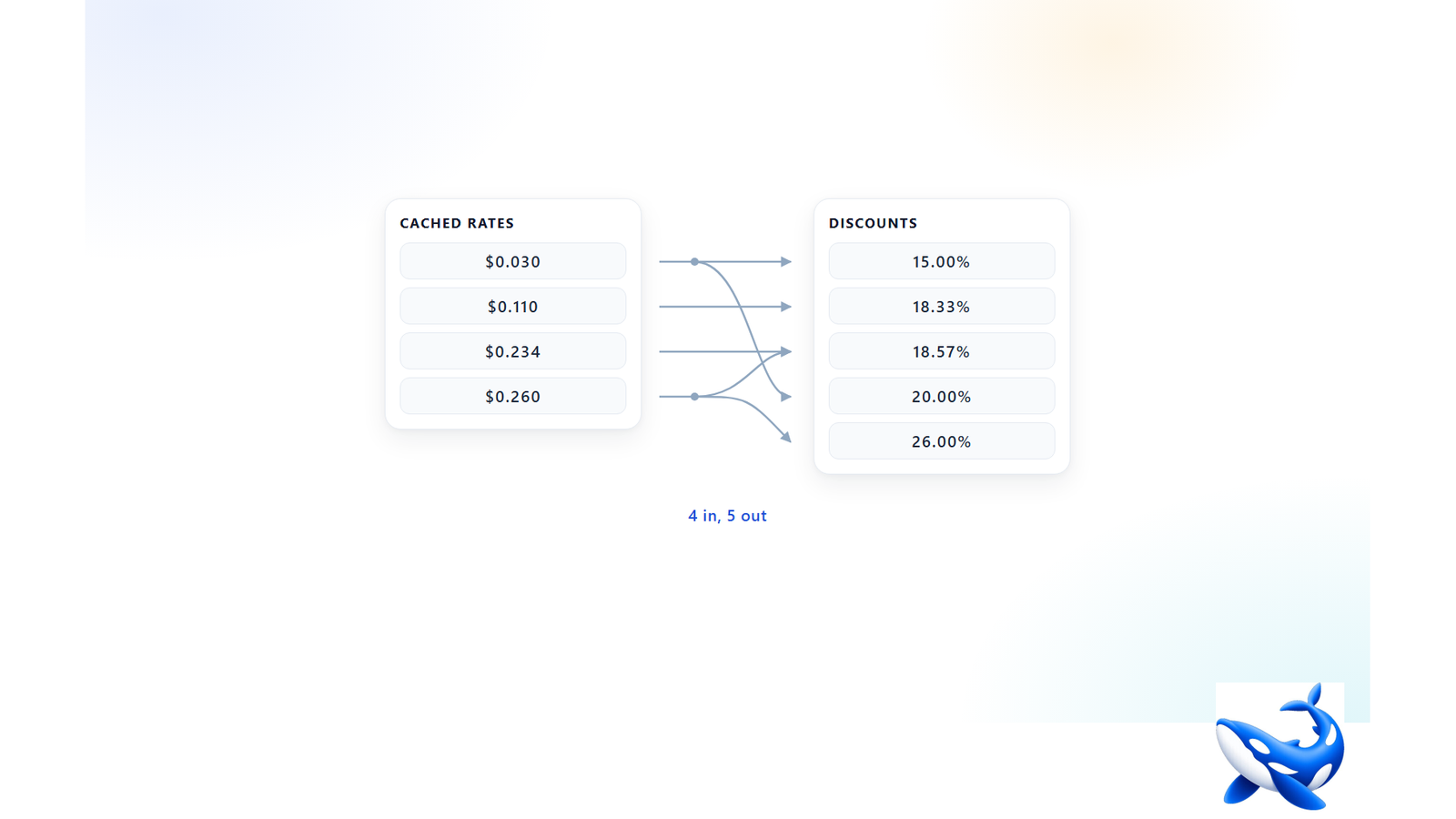
A row that costs 26 per cent more than another per uncached input token ends up costing eight tenths of one per cent more once a ninety per cent cache-hit rate is assumed, and the reason is a single column: the cheaper of the two carries a steeper cached discount [OURS]. Both rows sit on the OrcaRouter z.ai api page, and the mechanism behind that reversal is structural — the four distinct cached-input figures printed across its nine priced rows resolve into five distinct discounts, because two of those four figures are shared by rows whose input rates are not the same [VENDOR, read 2026-10-14].
Four in, five out is the kind of arithmetic that only happens when a column is derived rather than quoted, and it is worth walking through slowly, because the same table also contains the opposite case: three rows that reach one identical fraction from two different pairs of prices. Both facts are legible in the printed numbers, and neither is pointed out on the page.
Four cached figures, five discounts
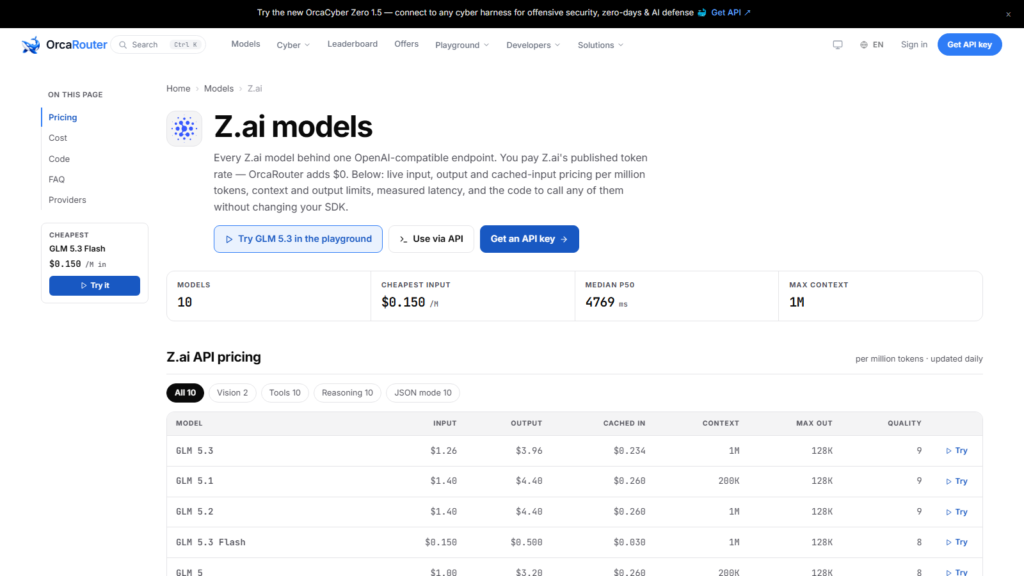
Read the catalogue’s priced rows and count what is actually there.
| Model | Input | Cached in | Cached share of input |
| GLM 5.3 | $1.26 | $0.234 | 18.57 % |
| GLM 5.1 | $1.40 | $0.260 | 18.57 % |
| GLM 5.2 | $1.40 | $0.260 | 18.57 % |
| GLM 5 | $1.00 | $0.260 | 26.00 % |
| GLM 5.3 Flash | $0.150 | $0.030 | 20.00 % |
| GLM 4.5 | $0.600 | $0.110 | 18.33 % |
| GLM 4.6 | $0.600 | $0.110 | 18.33 % |
| GLM 4.7 | $0.600 | $0.110 | 18.33 % |
| GLM 4.5 Air | $0.200 | $0.030 | 15.00 % |
Every rate in the first three columns is vendor-published and read 2026-10-14 [VENDOR]; the right-hand column is arithmetic performed on the other two, not a figure the page prints.
Nine rows, and the third column contains exactly four different numbers: $0.030, $0.110, $0.234 and $0.260. The fourth column contains five. The extra discount comes from the fact that two of the four cached figures appear more than once, and when they do, they appear next to different input rates — $0.030 sits beside a $0.150 input on one row and a $0.200 input on another; $0.260 sits beside a $1.40 input on two rows and a $1.00 input on a third. The cached figure is doing the work of a constant, and the discount is not.
That is the whole mechanism, and it has a practical consequence before the arithmetic gets any more interesting: a reader who scans the cached column for the lowest number learns nothing about which row is cheapest to repeat. The lowest cached figure on the page, $0.030, belongs to two rows whose discounts are 20 per cent and 15 per cent — the steepest small-figure discount on the page and the shallowest discount anywhere on it, from one number.
Three rows that reach one fraction two different ways
The first three rows of the table are the reason to do the division rather than eyeball the column. GLM 5.3 caches at $0.234 against a $1.26 input. GLM 5.1 and GLM 5.2 cache at $0.260 against a $1.40 input. Different absolute rates, different inputs, and the same fraction: $0.234 over $1.26 and $0.260 over $1.40 both reduce to exactly thirteen seventieths [OURS], which is 18.571 per cent and change.
Two things follow. The first is that the catalogue has an internal convention at that value — three of the nine priced rows land on it, and they are the three highest-scoring rows on the page, each carrying a nine on our own composite score, which is assembled from production traffic and published sources rather than a third-party benchmark [OURS]. The second is that knowing the fraction is not the same as knowing the price, because the two inputs involved differ by a dollar and a half per million tokens. A reader who has worked out that this catalogue discounts at 18.57 per cent for its top tier has learned something precise about the pricing policy and nothing at all about which of those three rows to buy.
The third row of the group is also worth a sentence for a different reason. GLM 5.1 and GLM 5.2 are identical on input rate ($1.40), output rate ($4.40), cached rate ($0.260) and maximum output (128K), and they separate on exactly one column: context, at 200K against 1M [VENDOR, read 2026-10-14]. That is the mirror image of a pattern seen on another catalogue, where two otherwise identical rows separated on the cached column instead — here the cached column is the one that agrees and the window is the one that does not. Both are the same lesson from opposite directions: on these tables the differences that matter are rarely the differences the row names advertise.
See also: How Keeping Up with Technology Improves Memory
What a ninety per cent cache share does to the ladder
Price ten million input tokens on each of the priced rows at a ninety per cent cached share — one tenth of the volume at the full input rate, nine tenths at the cached rate — and the column’s effect on the ranking becomes checkable.
| Model | Uncached, 10M input | Blended, 90 % cached | Share of its own uncached rate |
| GLM 5.1 / GLM 5.2 | $14.00 | $3.74 | 26.71 % |
| GLM 5.3 | $12.60 | $3.37 | 26.71 % |
| GLM 5 | $10.00 | $3.34 | 33.40 % |
| GLM 4.5 / 4.6 / 4.7 | $6.00 | $1.59 | 26.50 % |
| GLM 4.5 Air | $2.00 | $0.47 | 23.50 % |
| GLM 5.3 Flash | $1.50 | $0.42 | 28.00 % |
Every rate is vendor-published and read 2026-10-14 [VENDOR]; every blended figure and percentage is arithmetic performed on those rates, not a figure the page prints.
The ordering survives untouched: the cheapest row stays cheapest, the dearest stays dearest, and a multiplier applied to a list cannot reorder it. What does not survive is one particular gap. GLM 5 is priced at $1.00 per million input against GLM 5.3’s $1.26 — a difference of 26 per cent — and at a ninety per cent cached share they come out at $3.34 and $3.37 per ten million tokens, eight tenths of one per cent apart [OURS]. The steepest discount on the catalogue belongs to the cheaper of the two rows, and it nearly abolishes the price difference the table prints in bold.
The same table contains the counter-example that keeps this honest. GLM 5.3 Flash and GLM 4.5 Air share an absolute cached rate of $0.030, and caching barely moves the pair at all: the Flash row is 25 per cent cheaper before caching and 11 per cent cheaper after it. Where the shared figure sits on rows whose absolute prices are close together, the split in fractions is a real difference in the ratio and a small difference in the outcome. The steepest-discount story needs both halves of that — a large discount and a large base to apply it to.
The row that is not billed per token
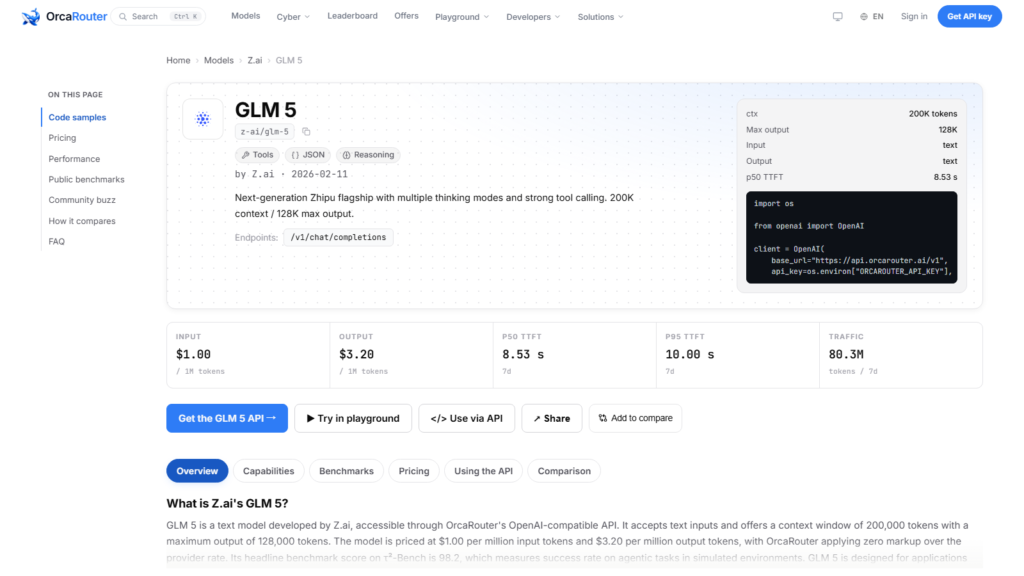
The tenth row on the page is charged per request rather than per million tokens, and it sits in the same table as the nine per-million rows [VENDOR, read 2026-10-14]. It carries no input rate, no output rate and no cached rate, because none of those quantities apply to it: a call-priced model costs what it costs however long the prompt was, so it is unaffected by your cache share in either direction and contributes nothing to the four-figures-five-discounts arithmetic above.
Two details about that row are worth noting precisely because they are easy to get wrong. A per-request row is not a free row — the page’s own header statistic names $0.150 as the cheapest input rate on the catalogue, and that figure covers the token-billed rows only, which is the correct treatment and also a reminder that the cheapest thing on this page cannot be compared on the same axis as the rest of it. And reading a blank cached cell as a zero is the same mistake in miniature: an absent rate means the quantity does not apply, not that the quantity is nothing.
The header strip itself is worth one paragraph, because it is where this catalogue differs from its neighbours. It reports ten models, a cheapest input rate of $0.150, a median p50 of 4052 milliseconds and a maximum context of 1M [VENDOR, read 2026-10-14]. There is no uptime figure on it, and the FAQ below the table answers the cost question by naming GLM 5.3 at $1.26 per million input and GLM 5.3 Flash at $0.15 as the cheapest model here — which matches the header exactly. Both statements are true and neither is complete in the way this article is about: GLM 5.3 is the dearest of the three rows that cache at thirteen seventieths, so the row the FAQ names first is the worst of its own group for any workload whose prompt repeats.
The takeaway
Read the cached column on this catalogue as four constants that produce five rates. The lowest cached figure, $0.030, covers both the shallowest discount on the page and a discount four fifths again as steep; the highest, $0.260, covers both the steepest discount here and the middle of the top-tier convention. The one finding with money attached is that GLM 5’s 26 per cent discount is steep enough to pull a row priced 26 per cent below GLM 5.3 to within eight tenths of one per cent of it at a high cache-hit rate — so if your prompt is a long frozen prefix, the price you were comparing is not the price you will pay. Measure your own cache-hit share before shortlisting, because it changes which pair of rows is even worth placing side by side.
Sourcing note: every input rate, output rate, cached-input rate, context window, maximum output and quality score cited is vendor-published and read 2026-10-14 [VENDOR]; the five cached shares, the identification of thirteen seventieths as the fraction three rows share, the count of four cached figures against five discounts, every blended figure and every percentage in the ninety per cent scenario are arithmetic performed on those published rates, not separate measurements, and are marked [OURS] where they carry a number in the text. The header statistics, the absence of an uptime figure and the FAQ answer naming the cheapest model are read from the page itself [VENDOR]. Quality scores are OrcaRouter’s own composite, assembled from production traffic and published sources, not a third-party benchmark [OURS]. The per-request row’s billing basis is the vendor’s own published description. The comparison with the Anthropic catalogue is drawn from that page’s own published table, read 2026-10-14 [VENDOR].