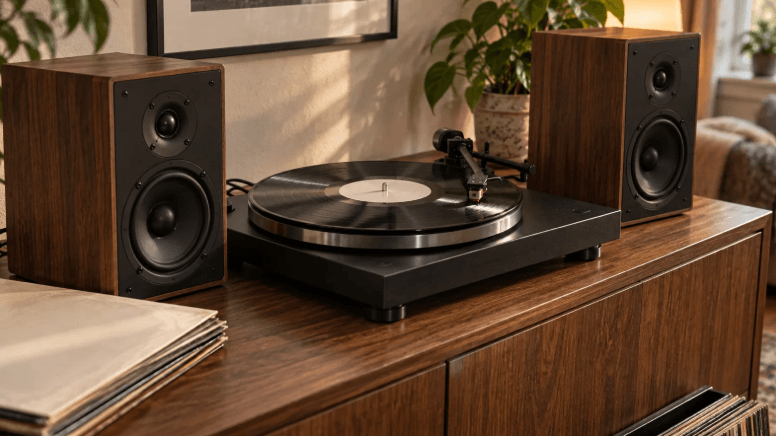
Understanding Phono Input Units and Their Role in High-Fidelity Vinyl Playback

Vinyl records continue to attract music enthusiasts who appreciate the physical experience of collecting albums and the distinctive character of analogue playback. However, building a quality vinyl system involves more than choosing a turntable and a pair of speakers. The components responsible for processing the turntable’s signal also play an important role in the listening experience.
One essential component is the phono stage. It prepares the low-level signal produced by a turntable cartridge so that it can be processed by an amplifier or preamplifier. As audio systems become more integrated, dedicated expansion modules are offering enthusiasts new ways to incorporate analogue sources without introducing unnecessary equipment.
Why Does a Turntable Need a Phono Stage?
A turntable cartridge produces a relatively weak electrical signal. This signal is significantly lower than the standard line-level output generated by devices such as CD players and many digital audio sources. It therefore requires additional amplification before it can be used by a conventional amplifier.
Vinyl records also use a recording equalisation curve known as RIAA equalisation. During record production, low frequencies are reduced and high frequencies are boosted according to this standard. A phono stage applies the corresponding inverse equalisation during playback, restoring the intended tonal balance.
Without the appropriate phono amplification and equalisation, a turntable connected directly to a standard line input may produce very quiet and tonally unbalanced audio.
A dedicated phono input unit combines these functions, helping the turntable work correctly with the rest of the audio system.
Important Features to Consider in a Phono Input Unit
Choosing a suitable phono stage requires attention to several technical characteristics. The right combination depends on the cartridge, turntable and other equipment in the system.
1. Cartridge Compatibility
Turntables commonly use moving magnet (MM) or moving coil (MC) cartridges. These cartridge designs differ in their electrical output and operating requirements.
A phono stage should provide suitable gain and input loading for the cartridge being used. Impedance selection is particularly relevant when working with different cartridge designs, as the electrical load can influence frequency response and overall performance.
Before purchasing a phono module, check its supported input settings against the cartridge manufacturer’s recommendations.
2. Gain and Signal Handling
Gain determines how much the phono stage amplifies the cartridge signal. Insufficient gain can result in low playback volume, while unsuitable gain settings may create unwanted noise or reduce available headroom.
A well-designed phono stage should provide amplification appropriate to the connected cartridge. Its noise performance is also important because the original signal from a turntable is relatively small.
3. RIAA Equalisation Accuracy
Accurate RIAA equalisation helps maintain the intended tonal balance of a vinyl recording. Variations in equalisation can affect bass, midrange and treble reproduction.
For listeners who value consistency across different records, the phono stage’s equalisation performance is an important specification to review.
4. Noise and Distortion
Low noise and distortion are desirable characteristics in high-fidelity audio equipment. Noise can become particularly noticeable during quiet musical passages, while distortion may affect the clarity of reproduced sound.
Manufacturers often publish signal-to-noise ratio and total harmonic distortion measurements. These figures can help buyers compare products, although listening preferences and the performance of the complete system should also be considered.
Integrating Analogue Audio into a Modern Hi-Fi System
Many modern audio systems combine digital and analogue sources. A listener might use a network streamer or DAC for digital music while maintaining a turntable for vinyl playback.
This arrangement can require several input connections and additional equipment. Traditional standalone phono preamplifiers provide one solution, but modular expansion offers another approach for compatible systems.
The LAiV audiophile phono input unit is an example of this modular approach. The Harmony LExt is designed specifically to expand the input capabilities of the Harmony HP2A headphone amplifier and preamplifier.
Its PHONO version integrates the phono amplification and RIAA equalisation stage into the HP2A system. This allows users to connect a compatible turntable directly through the dedicated phono RCA input, without requiring a separate external phono stage.
The module connects to the HP2A through LAiV’s proprietary LE-LINK interface. This design keeps the expansion within the existing system rather than requiring another standalone component.
See also: 4 Life Moments That Reveal Why Insurance Matters
Understanding the Harmony LExt Options
The Harmony LExt is available in two configurations, each serving a different purpose.
LExt PHONO is intended for vinyl enthusiasts. It provides a dedicated phono RCA input and selectable input impedance settings of 22Ω, 47Ω, 100Ω, 470Ω, 1kΩ and 47kΩ. The published specifications include 70 dB gain, a signal-to-noise ratio of at least 60 dB and total harmonic distortion figures of no more than 0.02% at 1 kHz and 0.01% across 20 Hz–20 kHz.
LExt IN2 is designed for listeners who need additional line-level connectivity. It adds one balanced XLR input and one single-ended RCA input, making it suitable for integrating sources such as CD players and network streamers.
Only one LExt module can be connected to the HP2A at a time, so users should select the configuration that best matches their primary requirements.
Planning a Balanced Vinyl Listening Setup
A good vinyl system depends on compatibility between its components. The turntable, cartridge, phono stage, preamplifier, amplifier and speakers or headphones should work together as a complete chain.
Start by identifying the cartridge type and checking the recommended gain and impedance settings. Next, consider how the phono stage will connect to the existing equipment. Cable quality, grounding and correct setup can also influence the reliability of the system.
For an HP2A owner who wants to introduce vinyl playback, the LAiV audiophile phono input unit offers an integrated expansion option. Its dedicated PHONO configuration combines the necessary phono processing with the convenience of a modular design.
Ultimately, the best solution is one that meets the technical requirements of the turntable while fitting naturally into the listener’s existing audio setup. Understanding phono amplification, cartridge compatibility and input connectivity makes it easier to build a system that supports both digital listening and the enduring appeal of vinyl records.