How a Record Actually Gets Made

Vinyl production is the only major music format whose manufacturing process would be recognizable to someone from seventy years ago. The equipment has been refined and the process is fundamentally unchanged: a groove is cut into a lacquer, that lacquer is used to create metal parts, and those parts stamp the groove into heated vinyl.
That continuity is part of why the format has the character it does, and it is also why production takes months rather than days, why quantities have minimums, and why decisions about the audio have to be made much earlier than for digital release.
Anyone approaching Vinyl Record Production for the first time benefits from understanding the sequence, because several of the choices that determine how the finished record sounds are made at stages most artists do not know exist.
Cutting the Lacquer
The first physical step converts audio into a groove.
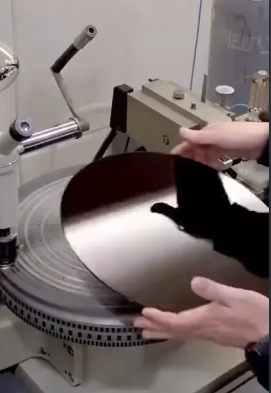
A cutting engineer works at a lathe, driving a heated stylus that cuts a spiral groove into a lacquer-coated aluminium disc while the audio plays.
The groove’s shape carries the audio. Its lateral movement encodes the sum of the channels and its vertical movement encodes the difference, which is why stereo information behaves the way it does on vinyl.
Groove spacing varies with the audio. Loud passages need wider grooves, which consumes more space, and quiet passages allow tighter spacing. The cutting engineer manages this in real time, and it determines how much audio fits on a side.
This stage is where the engineer’s judgment matters most, and a good cut from a sympathetic engineer makes a substantial difference to the finished record.
The lacquer is fragile and single-use. It cannot be played back conventionally without damage, which is why test pressings rather than lacquer playback are how artists hear the result.
Plating and Stampers
The lacquer becomes metal parts through electroforming.
The lacquer is coated with a conductive layer and placed in a plating bath, where metal deposits onto its surface.
Separating that deposit produces a negative of the groove, sometimes called the father.
Depending on the process used, further plating stages produce a positive, called the mother, and then further negatives, called stampers, which are the parts that actually press records.
The multi-stage approach allows multiple stampers from one lacquer, which matters for longer runs, since stampers wear and produce progressively worse pressings.
Shorter processes exist that use fewer stages and suit small runs.
This is invisible to the artist and it affects consistency across a pressing run, which is one reason quality varies between plants.
Pressing
The actual pressing is quick and the setup around it is not.
Vinyl compound is heated and formed into a puck.
Labels are placed in the press, which is why they become part of the record rather than being stuck on afterwards.
The puck is placed between two stampers and pressed under heat and pressure, forming both sides simultaneously.
The record is trimmed, cooled under pressure to prevent warping, and inspected.
Cooling time is a significant part of the cycle, and rushing it produces warped records, which is one reason production cannot simply be accelerated.
Quality control involves visual inspection and listening to samples, and standards vary between plants.
Why the Audio Has to Be Prepared Differently
Vinyl imposes physical constraints that digital formats do not, and ignoring them produces poor results.
Side length determines available groove space. Longer sides mean tighter grooves, which means lower volume and reduced bass. A side approaching or exceeding twenty-something minutes will be quieter and thinner than a shorter one, and this is physics rather than preference.
Bass content in the stereo difference signal causes cutting problems, which is why bass is frequently kept centred below a certain frequency.
Excessive high frequency energy and sibilance can cause the stylus to mistrack, and heavy limiting that works on streaming can translate badly.
Loudness works differently. The competitive loudness of modern digital masters cannot be reproduced, and a master prepared for streaming pushed onto vinyl usually sounds worse than one prepared for the format.
The practical implication is that a separate master for vinyl is worth the cost for anything where the sound matters, and that sequencing decisions should consider side lengths rather than treating the record as a continuous album.
Test Pressings and Approval
This stage exists because problems found afterwards are expensive.
A small number of test pressings are produced and sent for approval.
They should be listened to carefully, all the way through, on a decent system, checking for distortion, surface noise, skips, and anything that differs from expectation.
Faults found here can be addressed by recutting; faults found after a full run cannot.
Approving without listening properly, which happens under schedule pressure, is how artists end up with several hundred copies of a record they are unhappy with.
The turnaround for test pressings adds weeks to the schedule and it is not a stage to skip.
Why It Takes as Long as It Does
Production timelines for vinyl surprise everyone the first time.
Capacity is limited. Pressing plants are relatively few, the machinery is specialized, and demand has been high for years.
Each stage takes real time: mastering and cutting, plating, test pressings, approval, the pressing run itself, and packaging.
Packaging production runs in parallel and has its own lead time, and jackets, inserts, and sleeves all need printing.
Queue position matters. Plants schedule work and a project joins the queue rather than starting immediately.
Lead times measured in months rather than weeks have been normal for some time, and planning a release around an optimistic estimate is how launch dates get missed.
The realistic approach is to start the vinyl process considerably earlier than feels necessary, and to set the release date after the records are confirmed rather than before.